What happens when people have to guess to finish your form?
I know, another article about forms 🙄 But I promise this is different to the others, and besides, there’s a lot about forms, OKAY... This time I want to look at what happens to an answer someone only put in because the form wouldn’t let them continue without it.
Let’s say you’re filling in an insurance quote and it asks what your home is worth. You could put a number in, but you’re not sure whether they want what you paid or what it would sell for now.
In Baymard’s insurance research, a participant guessed their home’s market value and carried on, still unsure. I’d be worried about what happens when that quote reaches someone else, because they could be making a decision from that number without ever knowing the person was stuck on what to put.
Sometimes the question needs explaining. Sometimes we understand it perfectly and still don’t know the answer.
Help them find what to put
I might be able to recognise what my external walls are made of in a set of pictures even if I’m stuck looking at a list of construction terms. That’s what Baymard found when people answered questions about their roof or wall construction.
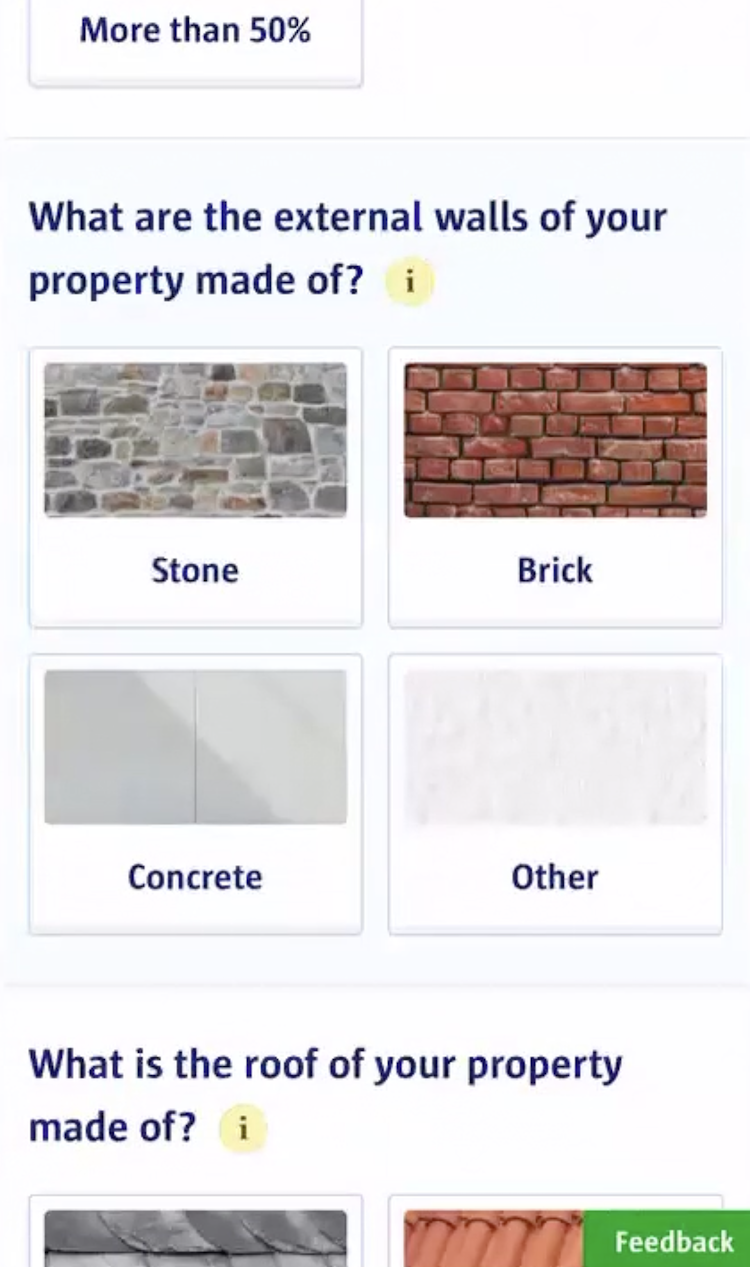
Now the next question asks what it would cost to rebuild my house, I’d need to go and find a way to work that out before I could put anything in, because who the heck actually knows that?
So if the form gives you no help finding that figure, you might turn to Google and find the Association of British Insurers website, which points you to a calculator. The calculator gives an estimate that you can then go back and use to answer that question (though some properties would need a professional assessment, so you could then have a much longer wait for your answer).
But instead of making me scratch my head and go looking for these tools, I’d want the question on the form to point me there, and I would HOPE that it saves my progress while I’m off elsewhere figuring it out (I also did a post on saving progress which I recommend you give a read too).
What if there isn’t more to find out?
But say I’m being asked when I lost my passport and I can only remember roughly when it happened, where am I meant to go to find that out? I might have only noticed 8 months after actually losing it 🤣
Now if you ask when a passport was issued, that’s something I can copy right from the passport itself (assuming I have it), so it makes sense for the fields to match the date printed there. BUT asking when I lost it looks like another date question, now you’re relying on what I remember, which is why GOV.UK’s date guidance uses that example for allowing an approximate answer. I wouldn’t want to give both questions the same day, month and year fields just because they’re both asking for a date.
Let’s say someone remembers losing it in June 2026, but they can’t get past the question without choosing a day as well, so they put in 2026-06-01 to carry on. They haven’t remembered anything more, they’ve just found a way to answer the question and keep going with the rest of the form.
What happens to that guessed day?
Now someone internally opens the submitted answers and sees 2026-06-01, and unless we’ve kept something alongside it, how would they know the person only remembered June? We might have said “an estimate is fine” beside the question, but they’re looking at the saved answer now, not the form with all its helpful explanations.
I’d want them to see June 2026 marked as approximate, on the review screen and in the saved record, which means letting the person give us that answer in the first place and keeping it that way. If all we’ve saved is 2026-06-01, we can’t tell whether they remembered the day or guessed it, so we can’t sort this out afterwards just by changing how the date looks.
A day is required
When did you lose your passport?
If you can’t remember the exact date, an approximate answer is fine.
Day01Month06Year2026“I only remember June, but it needs a day. I’ll put the 1st.”
What the next person sees
Submitted answers
Date passport was lost
2026-06-01
The guessed day now looks like an exact answer.
The month is accepted
When did you lose your passport?
Enter the month and year you remember. An approximate answer is fine.
Month06Year2026“I know it was June 2026, so I can put that.”
What the next person sees
Submitted answers
Date passport was lost
June 2026
Approximate. Month and year only.
The next person can see that the exact day is unknown.
What does the decision actually need?
Say we need to check whether the passport was lost before a particular cutoff date. Whether June is enough depends on that cutoff:
- Before July: knowing the event happened in June answers the question. Finding the exact day wouldn’t change the decision.
- Before 15 June: the event could fall either side, so I’d need a way to check when it happened, perhaps a dated document. We can’t use the first just because that’s what they put in the form.
And if they can’t find a document, we still have to do something with that mid-June case. I’d leave it open for checking and explain to the person what happens next, making sure whoever picks it up can see that only the month was remembered. Having 2026-06-01 sitting there doesn’t give them a reason to decide it happened before the cutoff.
So next time I’m reviewing a form, I’d try putting myself through it without having all the answers ready. Where I get stuck, that might mean helping me find a better answer, or keeping it visibly uncertain and working out who can deal with it. Before signing it off, I’d want to see what happens to my guess after I’ve pressed Continue, and whether the next person can still tell that’s what it was.