The Psychology Principles Product Designers Actually Use
Every design course teaches Gestalt. The more useful question is what psychology actually changes when you're deciding under pressure, when a PM wants to cut an onboarding step and the error state ships last.
The more useful question is what psychology actually looks like when you're making decisions under pressure: when a PM wants to cut a step from onboarding, when pricing needs rearranging, when error states are the last thing on the sprint backlog. That's where the real mental models live.
Here are the ones that change how experienced designers make decisions.
Cognitive load: the version that matters in practice

The textbook says: reduce cognitive load. The practical version is tougher. It's not about decluttering screens. It's about understanding what kind of thinking your interface demands, and whether users have the capacity for it.
Working memory is small. Research puts the limit at around four chunks of information. That sounds manageable until a user is doing your multi-step checkout flow while half-distracted, on a phone, in a queue. Their cognitive resources are already spent before they hit your form.
Decision fatigue is related to cognitive load, but subtler. The more choices you ask someone to make, the worse their decisions get, and the more likely they bail entirely. This isn't theoretical. It's why cutting options at the wrong moment tanks conversion.
Here's the hard part: simplifying navigation means reworking structure, not just removing visual clutter. Moving complexity off the screen often shunts it into backend logic, onboarding, or support tickets. The real question isn't "how do we show less?" It's "what does the user actually need to hold in their head right now, and what can we defer?"
Progressive disclosure answers that. Not as a pattern for its own sake, but as a deliberate choice about where the work lives and when the user is ready for it.
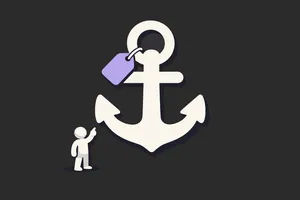
Anchoring: the first number shapes everything after it
Anchoring is one of the most well-documented effects in behavioural psychology. It operates constantly on pricing pages, plan comparisons, and feature communication.
The principle: the first piece of information someone sees sets a reference point that influences every evaluation that follows. If your pricing page leads with a £199/month enterprise plan, the £49/month mid-tier feels reasonable. Flip the order and that same £49 feels expensive next to a free tier.
This isn't manipulation. It's information architecture. Every pricing page makes an anchoring decision whether the designer thinks about it or not. Making that decision conscious, then testing it, is the job.
Anchoring shapes how users interpret new features too. If the first thing they hear is "saves you 10 hours a month," that sets the reference for what the product is worth. If they see a feature list first, the reference is complexity, not value.
This connects directly to how you frame the problem statement before designing. The framing you set upstream, what the product does, who it's for, what it costs, shapes how users interpret everything downstream.

The peak-end rule: why error states matter more than you think
Daniel Kahneman's research on memory, documented in Thinking, Fast and Slow, produced one finding that's useful for product design but often missed: people don't remember an experience as an average of its moments. They remember the peak (the most intense moment, positive or negative) and the end.
For product design, this matters. And most teams get it wrong.
Teams spend design cycles on onboarding and happy paths. They ship error states at the last minute, but the error state is often the peak of a user's negative experience.
Teams spend design cycles on onboarding, happy paths, and hero moments. They ship error states at the last minute with copy a developer dashed off between other tasks. But an error state, the moment something breaks, is often the most intense moment a user experiences. The empty state you show when someone first arrives and there's nothing yet is also a peak: their first real encounter with the product beyond marketing.
Both moments are outsized in how much users remember them. A failed payment with clear, calm, actionable copy is a different memory than "Error 500." An empty state showing what's possible is a different first impression than a blank screen with a tiny grey plus icon.
Make it a habit: audit your product's worst moments and its final moment before someone closes the tab. These aren't edge cases. They're disproportionately what users hold onto.
If you want more thinking like this, Unicorn Club is a free weekly newsletter for senior designers and product teams. Practical, short, worth your time.

The say-do gap: what bites teams who rely on surveys
Users do not tell you what they will actually do. Not because they lie. Because their stated preferences in a low-stakes research setting are genuinely different from their behaviour in the real, pressured, distracted world where they use your product.
Ask someone in a usability session whether they read terms and conditions. They say yes. Watch them actually do it. Three seconds of scrolling to the bottom.
Ask someone whether they'd use a product that tracks their fitness. They say yes. Check whether they install the app six weeks later. Often they don't.
This gap between stated and actual behaviour is why usability testing and observation matter more than surveys for decisions that matter. It's also why empathy maps need to be grounded in what users actually did, not just what they reported feeling.
For feature prioritisation, the say-do gap is sharp: user demand expressed in surveys is not the same as revealed preference in actual usage. A feature 40% say they want might be used by 4% if built as described. The only way to close that gap is to test with stakes that matter: real tasks, real scenarios, consequences the user cares about.
This doesn't mean user research is broken. It means different methods answer different questions. Surveys tell you about attitudes and mental models. Observation tells you about actual decision-making. Both are necessary. Mix them up and you get confident decisions based on the wrong signal.

Loss aversion: why feature adoption is harder than it looks
People weight losses roughly twice as heavily as equivalent gains. This is consistent across decades of research and applies directly to how users respond to change.
Redesign a navigation structure, and users don't encounter it neutrally. They experience the loss of the old one. The new version might be objectively better, but for a while it's worse: the user has to rebuild their mental model. This friction often gets misread as product feedback ("users hate the new nav") when it's just psychological adjustment.
The same pattern applies to upgrades. Communicating what a user gains ("three new features") is weaker than communicating what they miss by not upgrading ("your team is already using these"). This isn't dark patterns. It's about framing information the way people actually process trade-offs.
Loss aversion also shapes how users respond to onboarding that asks for a lot upfront. Every piece of information you request is experienced as a cost. Every setup step is something the user gives up: time, attention, anonymity. Reducing that cost isn't just fewer fields. It's making the exchange feel proportionate to what they get in return.
What this means for how you work
Psychology in design isn't a checklist you apply at the end. It's a lens you bring to decisions that already need making.
The useful questions:
- What's the first number or framing a user encounters, and what does it anchor?
- What's the worst moment a user can have in this flow, and what do they see and feel then?
- What's the last thing they see before they leave, and what does that memory feel like?
- What are we asking users to tell us that they might report differently from how they'd actually behave?
- What are we asking users to give up to use this, and does the exchange feel fair?
These apply to every sprint, every flow, every copy decision. The difference between a team that uses psychology and one that talks about it is whether these questions get asked before shipping, or only after the metrics come back.
Related reading: UX Concepts & Practices Glossary, definitions of the core methods that support evidence-based design decisions.
